Most circuits that look like they need a QPU are classically tractable.
measured on a self-generated corpus — scope · the publishable core →
Atlas answers one question before you spend QPU time or a week of HPC: does this circuit actually need a quantum computer, or can a laptop reproduce it? In our self-generated corpus of 2,517 circuits, the ones we built to look hard were classical far more often than not. Atlas decides the way worth trusting: measured, multi-method, auditable — not a guess. It separates signal from noise on that one call. It adds no PQC, no key-breaking, and no "quantum advantage" claim.
Free for everyone this launch month · no account, no limits. Open (Apache 2.0): the scalable engine (Stim/quimb/cotengra + route adjudicator + UI), the benchmark corpus, the reproduce scripts and the QPU result JSONs on GitHub. Not open: the proprietary research arsenal (n≤14 fold/spread) and the confidence model. Run it in your browser (hosted — your circuit is sent to the Atlas server to compute the verdict) or fully local on your own hardware (zero circuit egress). Details.
$ And it prices the decision — not just the physics.
Every vendor calculator prices their hardware. None tells you a laptop does it for free. Atlas prices both sides — the measured cost of running it classically, against published QPU pricing, fully auditable — so finance sees the spend-or-skip call, not just a qubit count. Each number is a dated, representative example that depends on the circuit and chosen assumptions — decision support, not financial advice.
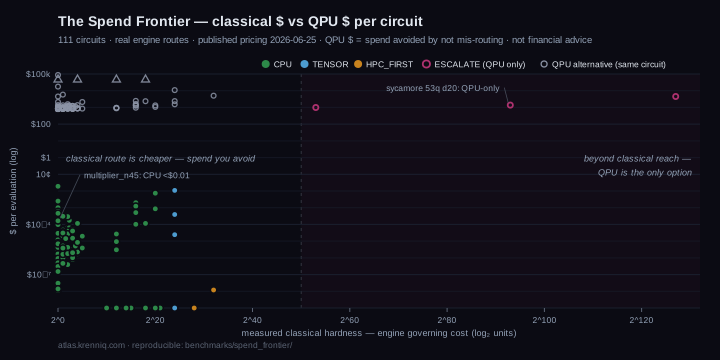
multiplier_n45: $0.000177 classically vs $17,560.86 on a QPU — measured, published pricing 2026-06. The QPU figure is a counterfactual: spend avoided by not mis-routing, not a saving.
Effective magic — the magic that actually matters.
A T-gate count tells you how much magic went in. The entanglement-spectrum anti-flatness (concept: Tirrito, Turkeshi, …, Hamma et al. 2024 — their published theory, credited) measures how much of it is braided into the entanglement versus cancelling out. Validated on real benchmark circuits: qft_n18 carries 459 T-gates and reads effective magic 0.000 — its magic cancels, and it routes CPU at bond 1 — while Trotter dynamics read 0.93–0.996. Extracted at zero extra cost from the exact MPS the router already builds, and shown in every verdict. We are not aware of another triage tool that exposes this as a routing-level signal.
Honest limits: computed only when the Schmidt spectrum is exact (it abstains when truncated — tractable/borderline regime only); Clifford circuits read 0 by theorem; it is a display/diagnostic signal — it does not change the route. Also new in the instrument: a per-circuit Walsh noise-cutoff display r*(p) (our measured damping law — terminal-noise exponent exact; the level-damping physics is the known noise-induced-simulability lineage); the certificate now publishes its own measured witness independence (≈2.3 effective of 3 single-method folds — an honesty practice, not a boast); and the QPU corroboration harness gained a Walsh level-profile + connected-C2 spoof screen (diagnostic only — the Fxeb validity bar is unchanged).
The concept, cited → See it in a live verdict →The problem, in plain language
Quantum hardware is scarce and expensive, and so is the HPC time it takes to simulate a circuit classically. The expensive mistake is running the wrong one: paying for a QPU on a circuit your laptop could have settled in seconds, or sinking a cluster into a circuit that was never going to be classically tractable. Today most teams decide this by intuition or rule-of-thumb. Atlas turns that decision into a measured, repeatable, auditable verdict — the same way a compiler decides CPU vs. GPU, but for the classical-vs-quantum frontier.
What Atlas is — and what it is not
The quantum market is saturated with two narratives: hype ("everything needs a QPU") and threat ("quantum will break everything"). Atlas does neither. It is a sober instrument that separates signal from noise on one decision — classical-tractable or not — and refuses to over-claim on either side.
| Atlas does | Atlas does NOT |
|---|---|
| Measure the cheapest classical method that handles your circuit, and exhibit it | Claim "quantum advantage" — that needs a lower bound over every classical algorithm (BQP≠BPP, open) |
| Say "don't buy the QPU" with a constructive, checkable witness | Touch post-quantum cryptography, key-breaking, or any "quantum threat" story |
| Abstain (MEDIUM) when the evidence honestly splits | Promise it can prove you need a QPU — the strongest honest statement is "out of measured classical reach → verify" |
What you get back
A laptop can handle it
Independent estimators agree the circuit is classically simulable. When the case is cheap and certified, Atlas can hand you the result — not just the verdict.
This one earns the hardware
No cheap classical route survives the checks. Atlas tells you so before you spend the QPU time, and shows you which estimator drew the line and why.
And a third, honest answer: MEDIUM — "I can't certify either side." That is not a failure. Deciding exact stabilizer-polytope membership — the magic resource behind classical hardness — is provably super-exponential (Leone et al., arXiv:2602.22330), so a calibrated abstention is the only honest answer when the evidence splits. Atlas never feigns certainty.
How it works, in three moves
Drop in a circuit
OpenQASM or a Qiskit circuit. No account needed for the free hosted web.
Four independent estimators run
Stim (#T / stabilizer), quimb (MPS bond), cotengra (treewidth), and Pauli-spread — each measuring the circuit from a different mathematical space.
A certificate, not a black box
A hash-stamped verdict with the per-estimator evidence ledger — re-derivable, archivable, citable.
The full reasoning — the four estimators, the agreement certificate, and the honesty principles — is on the Methodology page.
Where Atlas stands vs. the state of the art
Stated honestly, not marketed. Atlas does not try to beat the specialized engines — and shouldn't. It answers a different question.
| Layer | vs. SoTA |
|---|---|
| Quantum simulation (statevector / MPS) | well below — quimb / Aer own this |
| Tensor-network contraction · stabilizer · compiler | below — cotengra / Stim / Qiskit own these |
| Route adjudication — which method should you run? | potentially ahead — engines like Aer auto-route, but none emit a calibrated, auditable verdict + certificate + estimated $ cost |
| Explainability · failure-mode awareness | at or above |
Verify the number yourself
Don't take our word for it. The four papers Atlas cites are linked to their arXiv primary sources on the Methodology page — click through and check the characterisation yourself. And the data is public too: the calibration corpus, the confusion-matrix script, the hardware job-ids and the script that reproduces every figure are open, Apache 2.0, at github.com/fomv9354lve/atlas-engine — clone it and recompute every number (see Evidence). The code is open and so is the data; what stays ours is the proprietary research arsenal (the n≤14 fold/spread engine), not the measurements.
Frequently asked questions
How do I know if my quantum circuit needs a QPU?
Paste your circuit into Atlas. It runs four independent estimators (Stim, quimb, cotengra and Pauli-spread) and returns a calibrated verdict: classically tractable, QPU candidate, or an honest MEDIUM when the evidence splits. A "don't buy the QPU" verdict comes with a constructive, checkable witness — the actual classical method that handles the circuit. Atlas triages the decision; it does not claim to prove that you need a QPU.
Can a laptop simulate my quantum circuit?
Often yes. In our self-generated corpus of 2,517 circuits, many that we built to look hard were in fact classically tractable. Atlas measures the cheapest classical method that handles your circuit, and when the case is cheap and certified it can hand you the simulated result, not just the verdict.
What is quantum compute triage?
It is the pre-flight decision of whether to run a circuit on a QPU or simulate it classically — made before you spend QPU time or HPC hours. Atlas turns that decision into a measured, repeatable, auditable verdict, the way a compiler decides between CPU and GPU. The full reasoning is on the Methodology page.
How much does a QPU job cost vs classical simulation?
Atlas estimates the dollar cost of running your circuit on real QPUs (per-shot or per-minute, with device-calibrated mitigation overhead) and contrasts it against the measured classical cost. Every assumption is exposed and sourced on the Execution economics page. It is decision-support, not financial advice.
Is my quantum circuit classically tractable?
Atlas answers by measurement, not rule-of-thumb. Deciding exact stabilizer-polytope membership — the magic resource behind classical hardness — is provably super-exponential (Leone et al., arXiv:2602.22330), so Atlas returns a calibrated verdict with a witness when it can certify "classical," and abstains (MEDIUM) when the evidence honestly splits. It never feigns certainty.
How is Atlas different from Qiskit Aer?
Qiskit Aer, quimb, cotengra and Stim are simulation engines that each run one method. Atlas uses those open engines underneath but adds the layer on top: it adjudicates which method you should run and emits a calibrated, auditable verdict plus a certificate and an estimated cost. Atlas does not try to beat the simulators — it answers a different question: which method should you run, and how sure can it be?